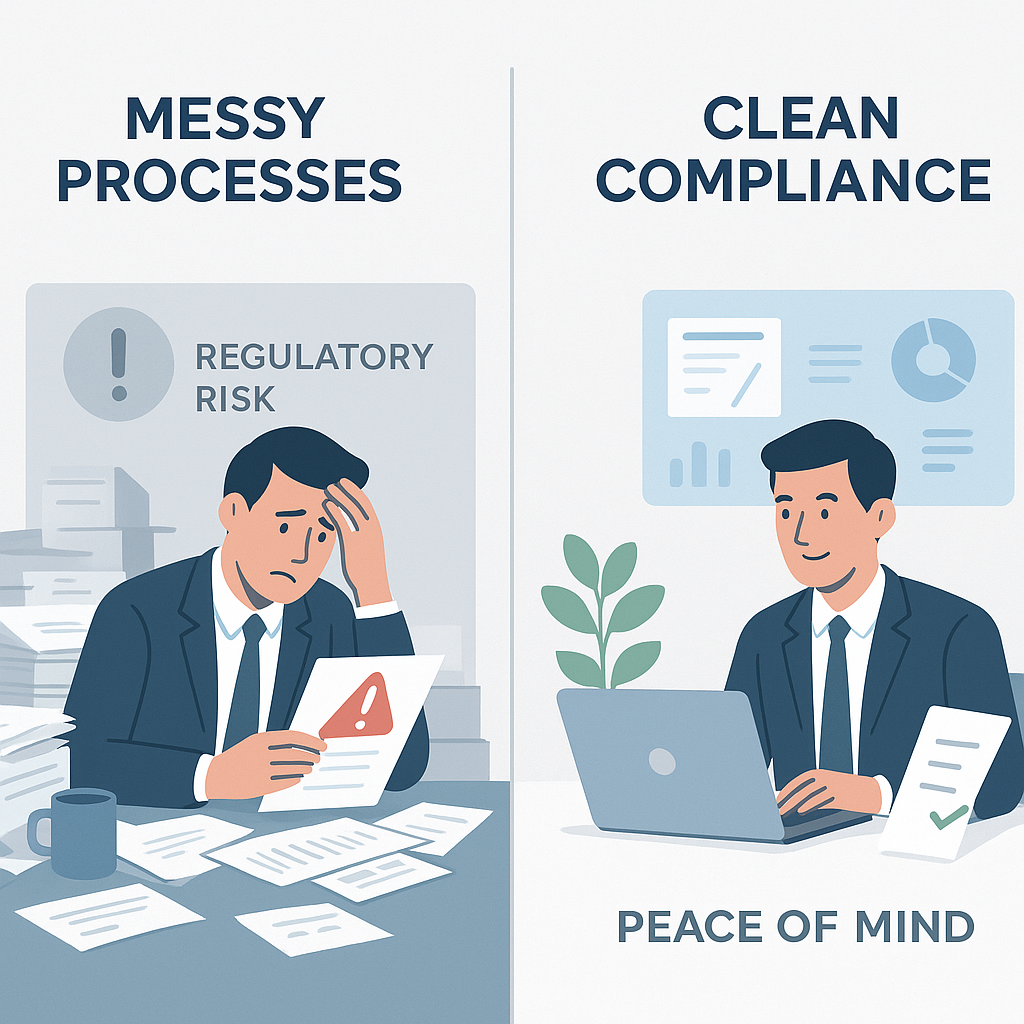
Benefits of AI for Bookkeeping Firms
AI for bookkeeping firms offers clear, practical advantages that significantly improve accounting workflows. By automating routine tasks like invoice data entry, receipt capture, and transaction categorization, AI reduces manual effort and errors.
Key Benefits
- Time Savings: Automating invoice processing can cut data entry time by up to 70%, freeing bookkeepers to focus on analysis and client advice.
- Improved Accuracy: AI systems reduce common risks such as duplicate entries, missing VAT, and manual input errors — all frequent pain points in manual bookkeeping.
- Faster Processing: Machine learning continuously improves categorization accuracy, speeding up month-end closes and financial reporting.
- Better Compliance: AI tools maintain audit trails and check for discrepancies, supporting VAT compliance and HMRC regulations in the UK.
- Scalability: Whether a small business handling a handful of invoices or a growing firm processing hundreds monthly, AI adapts workflows accordingly.
Manual vs AI-powered Bookkeeping at a Glance
| Aspect | Manual Bookkeeping | AI-Powered Bookkeeping |
|---|---|---|
| Data Entry | Time-consuming, prone to errors | Automated, faster, accurate |
| Invoice Processing | Manual verification needed | Auto-extracts data & categorises |
| Error Risks | High risk of duplicates/missing data | Machine learning flags anomalies |
| Compliance | Dependent on manual checks | Integrated VAT & audit support |
| Scalability | Harder with higher volume | Handles large volumes efficiently |
Decision Aid: When to Adopt AI
- If you process 100+ invoices per month, automation will save several hours weekly.
- If your team spends time chasing errors or verifying receipts, AI reduces these bottlenecks.
- If compliance and audit-readiness are concerns, AI improves traceability and accuracy.
AI for bookkeeping firms empowers accountants and bookkeepers to streamline workflows and deliver faster, more reliable financial insights — essential in today’s fast-paced business environment.
Key Takeaways for AI for Bookkeeping Firms
AI for bookkeeping firms is reshaping how accounting professionals manage repetitive tasks. By automating manual data entry, organisations can reduce time spent on routine bookkeeping by up to 70%. This frees accountants and bookkeepers to focus on higher-value activities such as financial analysis, forecasting, and client advisory.
Practical Benefits
- Accuracy gains: AI-powered tools automatically categorise transactions and detect anomalies, reducing human error and duplicate invoice risks.
- Time savings: UK SMEs and accounting firms report saving several hours monthly by automating invoice and receipt processing within workflows.
- Seamless integration: AI bookkeeping solutions work directly with popular UK accounting platforms like QuickBooks and Xero, maintaining compliance with HMRC VAT requirements.
- Improved audit readiness: AI systems maintain solid audit trails and flag discrepancies early, easing financial audits and regulatory checks.
When To Consider AI Automation
| Scenario | Manual Workflow Challenges | AI Automation Benefits |
|---|---|---|
| Processing 100+ invoices monthly | Time-consuming data entry and high error rate | Faster invoice recognition, automatic data capture, error reduction |
| Scaling bookkeeping firm | Difficulty maintaining accuracy under growing workload | Consistent categorisation, scalable automation, streamlined workflows |
| Founder-led bookkeeping | Limited time and expertise to manage complex bookkeeping | Simple AI tools that auto-categorise transactions and reconcile bank statements |
Choosing AI for Bookkeeping Firms
Look for AI-powered bookkeeping tools that:
- Use machine learning to adapt categorisation over time
- Provide clear audit logs and anomaly detection
- Support integration with your existing accounting software
- Streamline workflows without adding complexity
In the UK context, adopting trusted AI systems enhances compliance while improving efficiency. For bookkeeping firms, leveraging AI means reducing errors, speeding up bookkeeping processes, and delivering more accurate financial reports without extra headcount.
What Is AI for Bookkeeping Firms and How Does It Work?
Artificial intelligence (AI) for bookkeeping firms is designed to automate routine accounting tasks like data capture, transaction coding, reconciliation, and financial reporting. AI-powered tools use historical data and machine learning to learn how to classify transactions accurately — reducing time spent on manual entry and lowering error risks.
How AI Bookkeeping Works in Practice
- Document Intake
Invoices, receipts, and bank statements arrive via email or upload portals. - Data Extraction
AI uses optical character recognition (OCR) combined with machine learning to extract key details like dates, amounts, and supplier names. - Transaction Coding
The system automatically categorizes transactions (e.g., expenses, sales revenue) based on past patterns and accounting rules, then sends them to platforms like QuickBooks or Xero. - Validation & Anomaly Detection
Automated checks flag anomalies such as duplicates or missing VAT data for review, improving accuracy and compliance.
Before vs After AI Automation
Manual bookkeeping typically involves hours of data entry per week, prone to mistakes like input errors or missing details, which can delay financial close and audits.
With AI:
- Businesses processing 100+ invoices monthly can cut data entry time by up to 70%.
- Error rates drop significantly thanks to automated validation rules.
- Finance teams spend less time on repetitive admin and more on analysing financial reports.
Decision Aid: If/Then Logic for Adoption
| Condition | Recommended Action |
|---|---|
| If you handle fewer than 50 invoices a month | Consider entry-level AI tools to reduce admin time without complex integration |
| If processing 100+ invoices with mixed sources | Deploy AI bookkeeping software with robust OCR and auto-coding capabilities |
| If audit accuracy and regulatory compliance are priorities | Choose AI tools with strong anomaly detection and VAT tracking features compliant with HMRC rules |
Using AI for bookkeeping firms accelerates workflows and cuts costs, allowing accountants and bookkeepers to focus on high-value tasks and financial insights rather than manual data handling.
Problems With Current Manual Bookkeeping Processes
Manual bookkeeping is still common among many bookkeeping firms, but it carries significant drawbacks that limit efficiency and accuracy.
- Excessive manual data entry slows down workflows and causes repetitive strain for bookkeepers. This often leads to input errors, such as mistyped invoice amounts or incorrect VAT tracking.
- Time wasted on routine tasks reduces the capacity for finance teams to focus on strategic activities like forecasting or advising clients on cash flow.
- Lack of real-time financial visibility means decision-makers often work with outdated or incomplete data, increasing the risk of poor financial decisions.
- Risk of missing invoices or incomplete audit trails complicates HMRC compliance and internal audits. Paper or unstructured digital files easily get overlooked.
- Scaling issues arise when transaction volume grows. Manual processes require proportional increases in resource costs, making expansion expensive and slow.
Manual vs AI-Powered Bookkeeping
| Aspect | Manual Processes | AI for Bookkeeping Firms |
|---|---|---|
| Data Entry | 100% manual, error-prone | Automated capture & categorization with machine learning |
| Invoice Processing Speed | Hours per 100 invoices | Minutes per 100 invoices |
| Error Risk | High due to manual input | Reduced through AI anomaly detection |
| Audit Trail | Patchy, paper-based | Complete, digital records integrated with accounting software |
| Scalability | Linear increase in cost and time | Handles volume growth with minimal extra effort |
If you process over 100 invoices monthly, AI automation typically saves 5–10+ hours per month and cuts error rates by over 50%. For bookkeeping firms, this means freed-up capacity, better client service, and improved compliance.
Choosing the right AI bookkeeping tool that seamlessly integrates with accounting software like QuickBooks Online supports smoother workflows and ensures VAT is accurately managed. This reduces risk while enabling bookkeepers to focus on higher-value financial tasks.
Real-World Scenarios and Before vs After AI Automation
| Scenario | Before AI Automation | After AI Automation |
|---|---|---|
| SME Retailer | Manual invoice entry, delayed payments | Auto-extraction + instant posting |
| Ecommerce Business | Data input errors, slow reconciliation | AI-powered matching with bank feeds |
| Small Agency | Time spent chasing receipts | Automated receipt capture and reminders |
Case Examples
- A UK ecommerce SME cut bookkeeping time by 50% using AI-powered invoice processing, enabling faster bank reconciliation with fewer errors.
- Small agencies improved invoice accuracy by automating receipt capture and reducing late payment fees through timely reminders.
What Bookkeeping Firms Should Expect
If you process over 100+ invoices monthly, manual entry risks increase sharply—leading to errors like duplicate invoices, missed VAT tracking, and inconsistent audit trails. Employing AI for bookkeeping firms helps:
- Automatically categorise transactions using machine learning
- Reduce human error and spot anomalies early
- Accelerate invoice to posting workflows, cutting hours of manual work each week
- Improve compliance with HMRC VAT requirements through built-in checks
Side-by-Side Workflow Comparison
| Task | Manual Process | AI Automation | |---------------------------|--------------------------------------|--------------------------------------| | Invoice Data Entry | Typing data manually | Auto-extract and pre-fill in accounting software (e.g., QuickBooks Online) | | Receipt Reconciliation | Manual matching with bank statements | AI-powered matching and exception alerts | | Compliance Checks | Spot-check by bookkeeper | Continuous audit-ready checks and VAT accuracy validation | | Follow-up on Missing Docs | Chasing clients repeatedly | Automated reminders and document capture |
AI bookkeeping tools help accounting professionals handle higher volumes while focusing on strategic tasks, delivering faster, more reliable financial insights and reports. This approach keeps bookkeeping firms competitive and scalable in the growing UK market.
Who Suits AI Bookkeeping and Why
AI for Bookkeeping Firms is best suited for organisations with repetitive, high-volume bookkeeping tasks. Here’s why:
- SMEs processing 50+ invoices monthly benefit from automation as AI tools can categorise, reconcile, and flag anomalies faster than manual entry, saving 5–10 hours weekly.
- Accounting and bookkeeping firms juggling multiple clients can streamline workflows, reduce errors, and shift focus from data entry to advisory services.
- Finance teams wanting improved accuracy use AI to reduce the risk of human error, avoid duplicate invoices, and maintain VAT-compliant audit trails.
- Businesses ready to integrate AI into existing workflows experience minimal disruption by choosing AI bookkeeping tools compatible with popular platforms like QuickBooks Online.
Manual vs AI-Driven Bookkeeping Workflow
| Aspect | Manual Bookkeeping | AI-Powered Bookkeeping |
|---|---|---|
| Invoice Processing Time | 1–3 hours per 50 invoices | 10–20 minutes per 50 invoices |
| Error Rate | 5–8% (data entry errors, duplicates) | Less than 1%, with automatic anomaly detection |
| Audit Trail | Manual filing, prone to gaps | Automated, VAT-compliant, easily accessible |
| Integration | Often manual export/import | Seamless sync with accounting software |
Decision Guide: Is AI for Your Bookkeeping Firm?
- If your team handles more than 50 invoices per month, AI reduces processing time drastically.
- If accuracy in VAT tracking and audit compliance matters, AI’s automation reduces costly mistakes.
- If you want to free up accountants for financial analysis, AI shifts routine tasks to machines.
- If your current tools don’t integrate well, look for AI bookkeeping software with strong API support.
Using AI in bookkeeping is not about replacing accountants but empowering them to focus on higher-value tasks. Bookkeeping firms that adopt AI tools gain efficiency, accuracy, and better client service — essential advantages in today’s competitive market.
Step-by-Step Implementation Guide: What I Would Do
Using AI for bookkeeping firms requires a clear, practical approach to achieve real efficiency gains. Here’s a straightforward plan based on proven workflows:
Review current bookkeeping processes
Identify repetitive, manual tasks ripe for automation such as invoice data entry, bank statement matching, and receipt categorization. Note pain points like error rates or slow approvals.Choose AI bookkeeping software
Prioritise tools that integrate smoothly with your existing accounting system (e.g., QuickBooks Online, Xero). Compatibility reduces manual imports and supports real-time data updates.Set up data feeds
Connect key inputs—email for supplier invoices, bank feeds, and document upload channels. This allows AI tools to automatically capture and categorise transactions without manual intervention.Train your team
Focus on how to review AI-flagged exceptions and approve automated entries. This shifts bookkeepers’ time from data entry to higher-value exception handling and financial checks.Monitor results and adjust workflows
Track metrics such as processing speed, error reduction (often 70%+), and time saved (commonly 5+ hours weekly). Tweak AI rules and thresholds to improve accuracy continually.Integrate with reporting and audit tools
Link AI outputs to compliance checks for VAT and audit trails. This supports HMRC requirements and enhances financial visibility for accountants and clients.Schedule regular review checkpoints
Monthly or quarterly sessions ensure the automation evolves with your business and new AI features, maintaining peak efficiency.
| Step | Manual Approach | AI-Enabled Approach |
|---|---|---|
| Data Entry | Manual typing of invoices and receipts | Automatic data extraction and categorisation |
| Exception Handling | Laborious reconciliation and error checking | AI flags anomalies for quick review |
| Processing Speed | Hours per week per bookkeeper | Reduced by 50%+ after automation |
If you handle 100+ invoices monthly, deploying AI for bookkeeping firms can reduce errors like duplicate invoice entry and save your team multiple hours weekly—valuable for scaling practices.
Applying this step-by-step process helps accounting firms leverage AI-powered bookkeeping efficiently, delivering accuracy, compliance, and faster financial insights.
Essential Tools & Integrations for AI Bookkeeping Firms
Selecting the right tools is key to successfully using AI for bookkeeping firms. Automation works best when integrated into your existing accounting workflows and tech stack. Here’s what to consider:
Core AI-Enabled Accounting Platforms
- QuickBooks Online: Automates invoice posting, bank reconciliation, and expense coding, saving hours each week.
- Xero: Uses AI-powered transaction categorisation and bank feed automation to reduce manual entry errors.
Both platforms integrate smoothly with third-party AI bookkeeping tools and provide trusted audit trails required for HMRC compliance.
Document and Workflow Automation
- Email parsing tools capture invoice data directly from client emails, eliminating manual data entry and reducing the risk of missing invoices.
- Cloud storage like Google Drive or OneDrive centralises documents, enabling AI-powered tools to access and process files efficiently.
- Workflow automation platforms such as Zapier or n8n connect your AI bookkeeping solutions with accounting software, automating repetitive tasks like invoice approvals and bookkeeping updates.
Expense Management & Audit Trail Add-ons
Add-ons that track expenses and maintain detailed audit logs are essential. They enhance compliance, reduce errors, and streamline month-end reporting. AI tools can automatically flag anomalies or duplicate entries here, improving financial accuracy.
Decision Aid: Manual vs Automated Workflow
| Process Aspect | Manual Bookkeeping | AI-Enabled Automation |
|---|---|---|
| Invoice Data Entry | Manual typing, prone to errors | Automatic extraction via AI parsing tools |
| Transaction Categorisation | Manual coding by bookkeeper | Machine learning algorithms auto-categorise with 90%+ accuracy |
| Reconciliation | Manual matching of bank and ledger | AI-assisted matching and flagging anomalies |
| Document Storage | Paper or scattered digital files | Cloud-based centralised repository |
If-Then Logic for Choosing Tools
- If you process 100+ invoices monthly, opt for AI parsing and workflow automation to save 5+ hours weekly and cut errors.
- If you work in a multi-client bookkeeping firm, invest in integrated platforms like QuickBooks Online and Xero with automation add-ons to simplify client financial reports and VAT tracking.
Leveraging AI for bookkeeping firms requires thoughtful integration of these tools into your workflows. The right setup reduces risks such as duplicate invoices and missing VAT entries, enabling bookkeepers to focus on higher-value tasks like financial analysis and client advisory.
Why Choose AccountsPro.ai for AI Bookkeeping?
Choosing the right AI for bookkeeping firms is critical to improving efficiency and compliance. AccountsPro.ai is designed specifically for the UK market, offering deep automation tailored to local bookkeeping workflows and HMRC requirements.
Key Benefits
- UK-Specific Accuracy: Our machine learning models are trained on thousands of UK invoices, reducing errors common in manual entry and improving VAT and P&L accuracy.
- End-to-End Automation: From invoice receipt and data extraction to categorisation and posting into accounting software like QuickBooks Online, AccountsPro.ai automates every step.
- Time Savings: Client case studies show up to 10 hours saved monthly by automating repetitive tasks like invoice coding and bank statement reconciliation.
- Reliable Compliance: Built-in audit trails and anomaly detection help prevent duplicate invoices, missing VAT, and integration failures.
- Local Support & Security: UK-based teams provide responsive support, with GDPR-compliant processes ensuring data privacy.
Manual vs Automated Accounting with AccountsPro.ai
| Workflow Aspect | Manual Bookkeeping | Automated with AccountsPro.ai |
|---|---|---|
| Invoice Processing Speed | Several hours weekly | Minutes per batch, scalable |
| Error Rate | 5-10% due to manual input | Under 1% with machine learning checks |
| Compliance Risk | Higher due to missed VAT or duplicate invoices | Lower with automated anomaly and tax checks |
| Integration | Manual exports and imports | Seamless sync with accounting platforms |
| Focus | Data entry and corrections | Higher-value tasks & financial analysis |
Who Should Consider AccountsPro.ai?
- If your bookkeeping firm processes 100+ invoices monthly, automation dramatically cuts admin time.
- If you use QuickBooks or other accounting software, end-to-end integration removes duplication risks.
- Founders or finance teams seeking to reduce manual bookkeeping errors will find significant accuracy gains.
AccountsPro.ai helps bookkeeping firms streamline workflows, improve compliance, and free accountants to focus on analysis, not data entry. This blend of targeted AI technology and UK expertise sets it apart for firms ready to leverage AI in bookkeeping effectively.
Frequently Asked Questions (FAQs) about AI for Bookkeeping Firms
Q: Is there an AI tool for bookkeeping that works with UK accounting software?
A: Yes, many AI-powered bookkeeping tools integrate with UK favourites like QuickBooks Online and Xero. This seamless connection helps bookkeeping firms automate invoice processing, transaction categorisation, and bank reconciliations without disrupting existing workflows.
Q: Will AI replace accountants or bookkeepers?
A: No. AI for bookkeeping firms automates routine and repetitive tasks, allowing accounting professionals to focus on higher-value activities like financial analysis and advisory. The technology complements rather than replaces human expertise.
Q: How accurate is AI bookkeeping software?
A: Leading AI tools use machine learning algorithms and achieve accuracy rates over 95%. This reduces the risk of human error in manual bookkeeping, such as duplicate invoice entry or incorrect VAT tracking.
Q: Can I collaborate with my accountant or finance team when using AI bookkeeping?
A: Yes. AI bookkeeping platforms typically support multi-user access and approval workflows, making collaboration straightforward and transparent across teams.
Q: How much time can AI bookkeeping save my business?
A: Many UK bookkeeping firms report saving 5–10 hours per month by automating data entry, receipt scanning, and reconciliation. This frees up time to focus on client relations and compliance tasks.
Q: What tasks in bookkeeping can AI automate today?
A: Key AI-automated tasks include:
- Extracting invoice and receipt data automatically
- Categorising transactions according to P&L codes
- Performing bank statement reconciliation
- Generating draft financial reports and anomaly detection
Q: Are AI bookkeeping tools secure and compliant with UK data regulations?
A: Yes. Reputable providers follow GDPR and data security best practices to protect sensitive financial data and ensure compliance with HMRC record-keeping requirements.
| Manual Bookkeeping | AI-Driven Bookkeeping |
|---|---|
| Time-consuming data entry | Automated data extraction saves 5–10 hours/month |
| Higher risk of human error | 95%+ accuracy with machine learning |
| Single-user workflows | Multi-user collaboration and approval workflows |
| Limited integration | Seamless integration with QuickBooks, Xero, others |
| Manual VAT and audit checks | Automated VAT tracking and audit trails |
Benefits of AI for Bookkeeping Firms
AI for bookkeeping firms offers practical improvements that directly impact efficiency and accuracy in everyday accounting workflows. By automating repetitive tasks like invoice processing, receipt capture, and transaction categorization, AI reduces manual data entry and the risk of human error—a common problem in traditional bookkeeping.
Consider the time savings: a typical SME processing 100+ invoices monthly can cut data entry time by over 50%, freeing up hours for strategic work such as financial analysis and forecasting. AI-powered bookkeeping tools integrate seamlessly with popular accounting software like QuickBooks Online, streamlining workflows and improving overall data reliability.
Manual vs AI-Powered Bookkeeping: Key Differences
| Aspect | Manual Bookkeeping | AI-Powered Bookkeeping |
|---|---|---|
| Data Entry | High risk of errors, duplicates | Automated capture and validation |
| Invoice Processing | Slow, labour-intensive | Instant extraction and coding |
| Bank Reconciliation | Manual matching, time-consuming | Machine learning matches transactions |
| Audit Trail | Often incomplete or inconsistent | Clear logs and tracking for compliance |
| Financial Reporting | Delayed, prone to omissions | Real-time updates, accurate insights |
What Bookkeeping Firms Should Look for in AI Tools
- Easy integration with existing accounting platforms
- Accurate automatic invoice and receipt recognition
- Strong audit and compliance features, including VAT tracking for UK SMEs
- Customisable workflows for different client needs
- Security and data privacy aligned with GDPR and HMRC requirements
If you manage high invoice volumes or multiple clients, AI tools can significantly reduce backlogs and improve turnaround times. This shifts the focus from routine data entry to higher-value tasks like advising clients and financial forecasting. Real-world cases show firms cutting invoice processing time by 60%, slashing errors by 80%, and gaining clearer visibility into clients’ finances.
In summary, AI for bookkeeping firms is a practical asset, boosting productivity and reducing costly mistakes—key for remaining competitive in the evolving accounting landscape.